Tuesday, July 22, 2014

Event Three: Kayaking on the LA River


I was so thrilled to read that the LA River was eligible to count as one of our events in this class, because for the last year I've been dying to go kayaking on it, ever since I heard that such a thing was possible. What? Where? And HUH? The LA River has such a historically bad reputation, that every person I mentioned this to came up with some sort of wise crack about the filth I would encounter (Note: the LA River badly needs a brand overhaul). Near Elysian Fields there is a stretch of river with a sandy bottom, one of only 3 such sections in the 51 mile run of the LA River basin. Apparently the US Army Corps attempted to concrete over it, but the Glendale to Elysian Fields stretch is one of the deeper sections and one that easily floods so the concrete would simply not stay put, much to our modern day luck. 

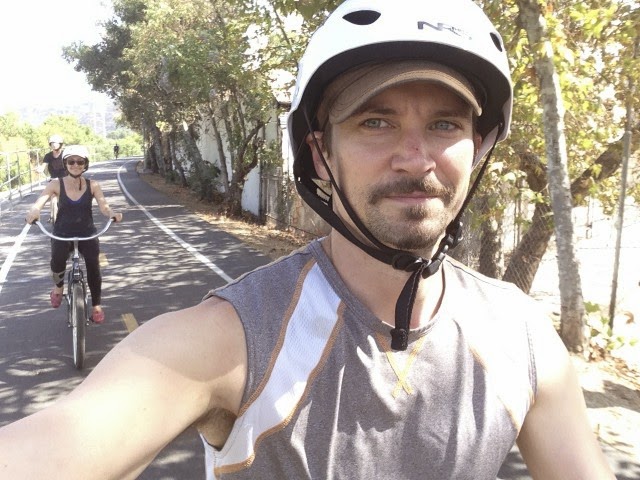
Our group (LA River Kayak Safari) started off by meeting at Oso Park and biking for about 20 minutes up along the south side of the river (a gorgeous, popular riding trail) until we reached the 'put-in' point, which was just south of the 2 freeway. After a 15 minute 'How to Kayak' lesson, we were in the water! 
As an extra treat and surprise, we had 4 scientists from The Natural History Museum who happened to be along on our tour that day, so we heard an earful about the ecosystem of the river, its fowl and fish and fauna. One of the most interesting things discussed was the health of the river. They told us that the river was deemed quite healthy and they were able to scientifically measure this in a few manners: One, the river contained healthy populations of dragonflies, mayflies and black flies, that apparently only breed in healthy water environments. Two, the fish in the river had been tested and the results came back below the acceptable levels of mercury for eating.  I learned that the majority of water in the LA River comes from runoff from water-treatement plants, which is probably a big part of how it gets it bad reputation. But apparently the water being offset into the river is only one grade below drinking level, which should make us all feel a lot better about what's really going on in there. 

The kayaking trip was a spectacular way to try something new in Los Angeles, enjoy the outdoors and support the ecological health of our city. Especially since I live on the eastside only about a mile from the river, I feel highly motivated to get involved with FoLAR and to eat at FrogSpot and to get a bicycle of my own so I can enjoy these awesome new trails that people are working so hard to create. I'm so proud of the Angelenos that are trying to take back our city and our waterways and turn them toward a healthier ecosystem and a source of joy for our residents. Bravo. 

Friday, July 18, 2014

Week Four, Part 2: NeuroScience + Art

I find there to be a natural and obvious connection and overlap between scientists and artists in the Neuroscience + Art information. To me, art & science dovetail quite easily and necessarily when it comes to the brain and exploration of human thoughts & emotions. I think this question of ‘What is consciousness?’ is at the heart & soul of many many artists' life searching and the crux of their work. 
One of the most beautiful examples from this week’s reading was the ‘Brainbow’ project, which allowed more than 100 neurons to be mapped at ones by the addition of different florescent colors. Created in spring 2007 by Jeff Lichen and Joshua Sanges, professors at Harvard, the resulting images are absolutely beautiful, and actually remind me of an abstract watercolor I just saw.  Also, a lot of the artwork shown in the lectures to illustrate the stories of the pioneers in LSD and cocaine work were psychadelic and striking themselves, and often reminiscent of the imagery from 'Brainbow' as well.  

Most resonant to me from this week’s reading was the work of Carl Jung, which I had been wanting to explore more of for quite some time now and which I’m compelled to study further when I have more time after this class. I related to his idea of global consciousness (and found the Global Consciousness Project to be an especially interesting pursuit) as something that intrigues me as well from a few of my own personal revalations throughout life. For example, in 2004 I was working in a remote location in Canada and became ill with blood poisoning that was caught only about 24 hours before it would have killed me. In the resulting dreamlike state, I felt pourous, at peace, and hardly separate from the people around me. Ever since then I have a belief in a global unconscious and a basic human interconnectedness that we haven’t yet explained. Therefore Jung's conception of universal consciousness was quite profound and interesting to me, and I'd like to learn more about it. 

Jung’s archetypes -- The Self The Shadow The Anima The Animus The Persona -- gave me more clarity on a character I played over a decade ago in college. As a freshman, I played a character named ‘Animula’ in a play called The Trap, about the life of Franz Kafka. I was to represent the soul of Kafka as a 9 year old child in a white dress, who opens the play with a 4 page monologue primarily in German (I believe this part really represents sort of an unconscious dream state), and then spends the remainder of the play on stage, unspeaking in various places off to the side doing things like playing jacks and jumping rope. Now I’m looking at this from a psychological viewpoint -- Kafka’s Jungian ‘Anima’ is always present, the softer feminine side of him hidden from everyone else’s view but visible to the viewers of history as you glimpse his vulnerability in relation to all the horror he experienced in his life. 
Another quick favorite from the reading, this one made me laugh out loud: "In 2003, with the aim of achieving immortality, conceptual artist Jonathon Keats put his brain, as well as its original thoughts, up for sale. To comply with the conventional rules of commercial markets, he registered his brain as a sculpture created by himself through the act of thinking. He then facilitated the sale by producing an exhibition and catalogue at the San Francisco Modernism Gallery. The artwork consists of MRI images of his brain activity as he thought about art, beauty, love and death.” I find that so delightful. 


I’m also reminded of the Tony winning musical ‘Next To Normal,' which deals with Bipolar 2 Disorder and its effects on a grieving family. I saw Alice Ripley in a production at the Ahmanson about 4 years ago. I don’t love the musical, but approaching it from a scientific standpoint and now from my own experience with postpartum, I appreciate it much more. I particularly love this song, which deals with a daughter’s feelings of invisibility in her family after the death of her brother, the ‘golden boy’ of the story, who torments his still alive mother with songs of what could have been and temptation into believing he’s still alive. 


Sources
Brainbow | Center for Brain Science
Artwork: Inspired Motherhood by Melanie Biehle
Video clip from Next to Normal
Review of Proust Was a Neuroscientist
Neuroscience + Art: Lecture II 

Week Four, Part 1: BioTech + Art

Of all the art forms we’ve studied so far, for me BioArt is where the line between art and science becomes so blurred that it’s impossible to distinguish one from the other or to give this work such a boxed-in title.  
I think this question in particular is the most difficult to answer: Should the restrictions be more or less stringent for artists using medicine, biotechnology ad neuroscience than for scientists in industry/academia? If pressed, I think I would say the restrictions should not be based on the person’s title, but on the problem attempting to be solved. If the problem is at a level of obvious human benefit ie: defeating cancer cells, the restrictions should be less. If the problem is of a ‘lighter’ weight, ie: let’s see if I can implant a human ear on my arm, then yes, I do think that not everything should be allowed, particularly when it comes to the experience and pain levels of other living creatures. Therefore, I do not agree with allowing animal testing for beauty products, but I understand the necessity for it in projects that could eventually save and extend human lives and lower human suffering. Of course now we get into the existential question of what makes a life valuable, are some lives more valuable that others, etc etc. 
I think there’s the potential for a lot of BioArtwork to become narcisstic and unecessary. For example, Alba the rabbit seemed to be mostly something that Joe Davis created just to see if he could. And I think when your artwork is messing with living beings that feel pain and joy and emotion, the ethics gets very very tricky! For example, just because you’re a French trained chef who prepares a beautiful sous vide pork belly, doesn’t mean that Wednesday night dinner for your kids is the appropriate place to use that technology and knowledge. I feel similarly about Joe Davis -- just because he put in the time and research to understand the glowing jellyfish cells, doesn’t mean that creating a glowing rabbit is the appropriate place to use that technology.  I found Kathy High’s work caring for lab rats really touching and sad and beautiful and pointless and meaningful all at the same time. I found it disturbing in the most profound humanistic sense because to me it is a metaphor for the pointlessness and meaning of life and how one spends one’s time here on earth. Adding to my confusion, Kathy High’s work with ‘Rat Laughter’ (which is attempting to answer the question, Can rats communicate their level of well being through ultrasonic sounds?) is to me a valued scientific and not artistic experiment, even though she defines herself as a visual/media artist.
This class actually sparked a heated conversation between my husband and myself at our date night this week.
I brought up my difficulty in determining whether a lot of these people were primarily artists or primarily scientists. My husband’s perspective is that it depends on the viewpoint of the consumer of their products -- ie whether they experience the end result as art or science. Myself, I don’t think that someone’s self-definition should be primarily related to result, but should be connected more to personal process. For example, if I consider myself an artist and discover a cure for cancer during my creative biotech experimentation, does that then make me a scientist? If I’ve trained as a scientist and consider that my profession, and develop technology that is then hung in an art gallery, am I now therefore an artist? See, I’m stumped because I don’t think I even have an answer here! The line between the Two Cultures becomes quite blurred for me.  
On the positive, enjoyable side of this week's intellectual dilemmas, I was tickled by SymbioticA & Adam Zuretsky-- I really appreciate the humor he brings towards his experiments. In a world that often seems to be populated with people who take themselves too seriously, I value his light attitude and the joy he brings to his work. This project in particular made me giggle: "The Brainus is an anus made of biopolymers, which was then seeded with brain tissue. The Analolly is a lollypop made of biopolymers, which was then seeded with anal tissues. The primary tissues used for these sculptures were taken from a dying eel. The eel was killed for food and the primary brain and anal tissues were isolated from the waste of culinary excess. The public is invited to vote: Which would you rather lick? Brainus or Analolly and Why?"


My absolute favorite project from this week is Natalie Jeremijenko’s ‘Impatient’ health clinics in Manhattan. Again, is this eco-activism, or interactive performance activism art, or creative medicine? I LOVE all her theories and plans and dreams for how to deal with the environmental issues in Manhattan. “Reimagining our relationship to natural systems” reminded me of the work of FoLAR in reestablishing a natural environment around the LA River. “Displacement is not the way to deal w environmental issues” reminds me of this RadioLab story where they were shipping NYC waste out to somewhere in the midwest but it was actually, in this case, beneficial for both places. I wonder what Natalie's viewpoint would be on this solution. I love what a problem solver she seems to be, particularly her solution for putting living gardens right in the street in front of fire hydrants in Manhattan. Absolutely brilliant, and now I can't see a hydrant in LA without thinking we should have some sort of small succulent garden living there. Or course, we're a different climate, so it's a slightly different issue, but I love all these environmental solution thoughts I'm having since hearing about her work! 


Resources:

Thursday, July 10, 2014

Week Three: Medicine + Technology + Art

What I’m finding most helpful about this class so far, is it’s providing me with a new lens through which to view formerly daunting subjects like science and math, which I usually find tedious. When I’m given the permission to view them through an artist’s eyes, they seem to come alive with possibilities and whet my appetite to know more. It's been so inspiring to be introduced to so many artists blurring the line between the two cultures, typically thanks to the use of technology. My head has been swimming with ideas. 
Simultaneously, this exploration of art meets the medical world was probably the most emotionally unsettling week for me. I found Mona Hatuom’s work 'Corps Etranger' (mentioned in the MRI as Portrait  reading) particularly... shall we say... disgusting. The exhibit consists of a round room wherein the viewer is treated to a close up view of her endoscopy. Orlan’s body-based art was somehow less unsettling but more shocking (in a good way). To me, her quest to document her pursuit of beauty ideals is akin to our culture’s relationship with the meat industry -- how we want to eat it but we don't want to see how it’s made. Similarly, we want to see beauty but not the pain that goes into creating it. Our culture wants to dictate and control female beauty but we don’t want to see the contortions that women put themselves through to achieve it, which is to me what Orlan is attempting to challenge. 
I’m finding that I’m really disturbed by art that exposes the inside of things. I ran across this work by Laurin Dopfner  in which he uses an industrial sander to peel away the layers of inanimate objects. It strongly reminded me of the Visible Human Project, the process of slicing an external body into thin cuts, revealing each layer along the way. I’m not sure I would have found the camera reveal art as disturbing if I wasn’t simultaneously studying the Visible Human Project, but either way I would have found it fascinating.
On the positive side of things, I loved the discussion of medicine originally being seen as an art and not a science, and loved the connection made between original anatomical drawings  functioning as a game changer for both artists and doctors/scientists. Another favorite was Diane Gromala‘s TED talk and her work with virtual reality to combat physical pain. I found it nearly impossible to determine if I would call her an artist or a scientist, bringing it back to the first week’s discussion of Third Culture.
I also remembered a work I’d seen at the Palm Springs Contemporary Art Show a few years ago, Blood Work by Jordan Eagles  He works with bovine blood, copper and resin to create absolutely stunning color masterpieces. 

Probably my biggest takeaway from the week was my fascination with Kevin Warwick’s Cyborg 2.0 project, where he implanted an electrode ray in his left arm to transmitted his nerve signals to robot arms. He’s also connected neurally with his wife and they are capable of sending messages in Morse code to each other directly from brain to brain (what the ????). Hello, has nobody considered that you could use this technology to take down a casino or win a game show or ... the (illegal) possibilities are endless. My husband writes crime thrillers, so I immediately drew his attention to the possibilities for using this real-life technology in story. Warwick is another one of those innovators who I would be hard pressed to make a decision between calling him an artist or calling him a scientist. 

(Above is Didou's MRI-influenced sculpture, Eco, which I just wanted to include somehow because I loved it!)

SOURCES


'Eco' Sculpture by Didou


Monday, July 7, 2014

Event Two: Pompeii at the California Science Museum


On a whim this weekend, my family decided to blow off [yet another] toddler birthday party and head instead to the California Science Museum downtown, where they were exhibiting 'Pompeii' for the summer.

I did find quite a few elements to tie it into our studies. For example, the exhibit mentioned how the old masters of art believed that in sculpting, the body should be 7 times the height of the head (Week Two: Math + Art) -- this sculpture to the left was built with those proportions. And many mathematically based tile works, like the one below, were included in the exhibit.

Overall, although I find the subject matter of Pompeii fascinating (particularly how the shapes of the bodies were preserved for years in the hardened ash), I found the exhibit to be simplistic and honestly, not that informative. Maybe it's just because I was comparing it to the Expressionism exhibit, or maybe it's intended to be accessible to a younger audience, but it seemed to be dumbed down and pumped up to be a larger experience than it actually was. Kudos to the museum for making a big event exhibit out of relatively minimal material, though!


My oldest son had a fantastic time with a child-focused hands-on exhibit about how to build an arch, combining engineering, architecture and art.  And my littlest was content to crawl around in the technology sector, while I explored exhibits such as how a camera flash works, what makes a wind tunnel, and how television functions. 

The space travel section was a big focus of the Science Center, as the Explorer has come to live there. It was a separate exhibit which we didn't pay to see, but there were lots of photographs to experience it's arrival through, as well as pieces of the Apollo and astronauts space suits to photograph.

I'd never been to the CA Science Center, so I was glad we had the chance to experience it. It seemed similar to other science centers I'd been to recently, like the Children's Museum in Atlanta, and Science North in Sudbury, Ontario. Traveling with small children in tow, as I do for work, I've found myself in many similar places over the past few years! Overall I found this one to be a bit dated and heavy handed, but as I have many fond memories of the (now extinct) Los Angeles Children's Museum from my own childhood, I'm still glad that such a place exists for my own little ones.


Wednesday, July 2, 2014

Event One: Expressionism at LACMA


Over the weekend, my mother came into town and we went to LACMA to view the exhibit Expressionism in Germany and France: From Van Gogh to Kandinsky. As a trained painter, I find expressionism to be one of the most electric, exciting and inspiring styles of painting so it was an exhibit I'd been looking forward to all year. It did not disappoint.

There were a few notable works from Van Gogh & Kandinsky (obviously), some from Matisse & Cezanne, and a few from a painter new to me, Paul Signac. I was especially happy to see a lithograph from Toulouse-Lautrec, one of my favorite artists, and I would have liked to see pieces from Expressionist artist Egon Schiele, but as he's Austrian, his work wasn't included. I'll just have to keep my eyes open for the next Expressionism exhibit in SoCal.

While we were there, we also stopped by the Metropolis II exhibit, which I found to be of particular interest given the Two Cultures blog topic the first week. An enormous city with streets for thousands of matchbox cars to 'drive' on, they rise on a pulley and descend with gravity, similar to marble exhibits I experienced in the center of the mall near where I grew up - a friend suggested these could have been by George Rhoads. Add in electrified trains, and the entire exhibit seemed to me to be a great blend of art & science, requiring significant engineering skill to accomplish (not to mention some sort of huge warehouse to construct it in -- where do these artists find so much space in the city??). Conceived by artist Chris Burden, who also created the mass of light poles in front of LACMA, the complex structure took four years to complete and I found it exciting and joyful, as did the small sea of children who surrounded it with excitement.

We also saw Alexander Calder's mobiles, which are really the perfect embodiment of art & math/engineering. Coincidentally, my son was also studying Calder in his preschool class last month (how LA is that??).

Overall, I think this is a fantastic time of year to visit LACMA, with lots of applicable exhibits for our course, as well as some simply beautiful classic artwork from history.

Week Two: Art + Mathematics

The intersection of art and mathematics is an easier concept for me to grasp than last week’s focus on science, as I trained as a painter for many years. Perspective line drawing (as discussed in the lectures) was something hammered home to me, although I’ve rarely thought about how mathematically based it is. The Vetruvian Man and DaVinci’s work as a whole were also quite familiar and enjoyable to revisit and I enjoyed the creative concept behind E.A. Abbott’s Flatland, although I did not enjoy the essay itself. I found it overlong, classist and sexist, though I suppose that shouldn’t be surprising as it’s written by a 19th century English man. (But really? Women are just lines and have to emit a ‘peace cry’ to keep the men safe? Why could they not be represented by circles, which is how women’s curves are represented in a large number of artworks? Ugh, don’t get me started.)
I was also familiar with the golden ratio for faces from my previous art study so I recognized Jimmy Ruska's explanation in the video Golden Ratio video.  There was a documentary done about a decade ago talking about this concept and how infants are actually shown to biologically prefer more beautiful faces (ie faces that adhere to the golden ratio). I remember Halle Berry being the example of the most beautiful face possible. I can't remember the name of that specific documentary, but I found this 'Human Face' BBC documentary series expanding on the concept: 


The Hyperbolic Crochet work by Daina Taimina was of great interest, and reminded me of artist Emily Barletta, who has Scheuermann’s disease and crochets work meant to represent the diseased cells that have meant living much of her life with great pain.  The viewing on fractals were really informative and I followed the rabbit hole to this Ted talk on African fractals, as well. My husband actually wrote a whole script centered around the Fibbonnaci sequence so these concepts have been floating around in my world for quite some time, though I never knew the word 'fractal' before this reading. 
Of all of the reading for the week, I particularly LOVED Theo Jansens’ creatures. Honestly, he’s reminiscent of a modern day Dr. Frankenstein, calling his works ‘animals’ and talking about their survival and will to live. Kind of creepy, definitely narcissistic (he’s reinvented the wheel; really?), but certainly brilliant. My husband and sons are really into robots so it helped me make more of a connection between how those could be considered “art.” Fusing these two concepts of science/mathematics and artistic intent together really made me excited to experience this world further with my boys and gave me a more personal window to view it through. 
I enjoyed the interview with Nicholas Gessler and learning about the history of textiles -- I recognized the Jacquard loom revolution as the origin for the word ‘Luddite,’ which came up often in last weeks reading of Two Cultures.  Similarly mathematical and scientific, in the vein of the Jacquard loom, Eske Rex created a HUGE ‘drawing machine’ that makes brilliant and huge ballpoint pen creations.


And another one by artist Sarah Gee that remind me of teeshirts I used to make at these 'art shops' in the 80s (ok now I’m REALLY dating myself!).


SOURCES
Flatland
Golden Ratio video
BBC Documentary
Hyperbolic Crochet
Photos of Emily Barlotta's work
African fractals
Theo Jansen's Creatures
Interview with Nicholas Gessler
Eske Rex
Sarah Gee's Drawing Machine on Vimeo